Token-Aware QoE Optimization for Multimodal AIGC Inference Tasks in Space-Air-Ground Integrated Networks
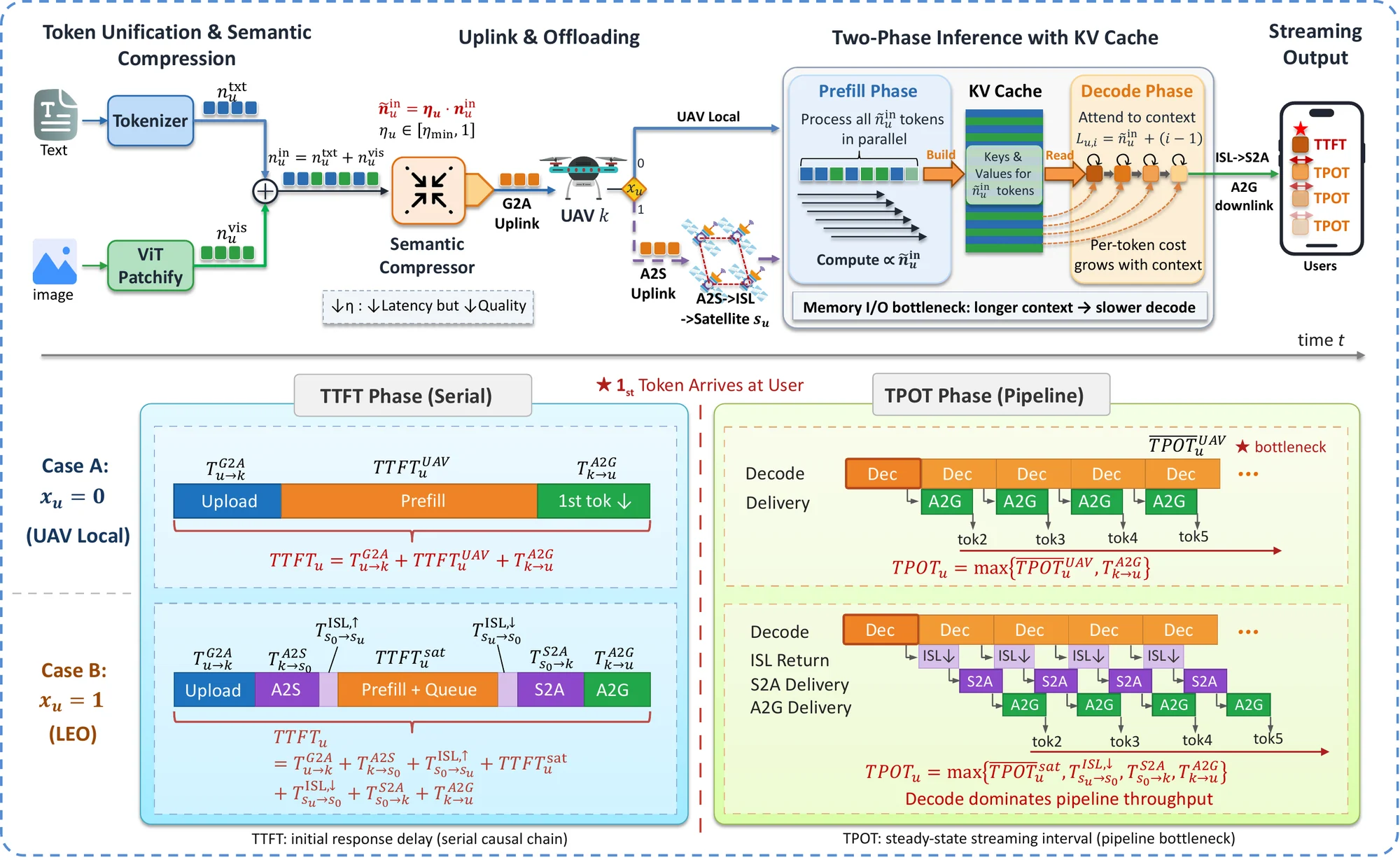
把通算协同的粒度从任务级细化到 Token 级:用输入、视觉和输出 Token 刻画多模态推理工作量,慢时标规划、快时标调度,兼顾响应速度、推理质量和业务体验。
- +31.9%
- 单用户 QoE,相对 TD3
- +69.2%
- 单用户 QoE,相对 Greedy
把通算协同的粒度从任务级细化到 Token 级:用输入、视觉和输出 Token 刻画多模态推理工作量,慢时标规划、快时标调度,兼顾响应速度、推理质量和业务体验。
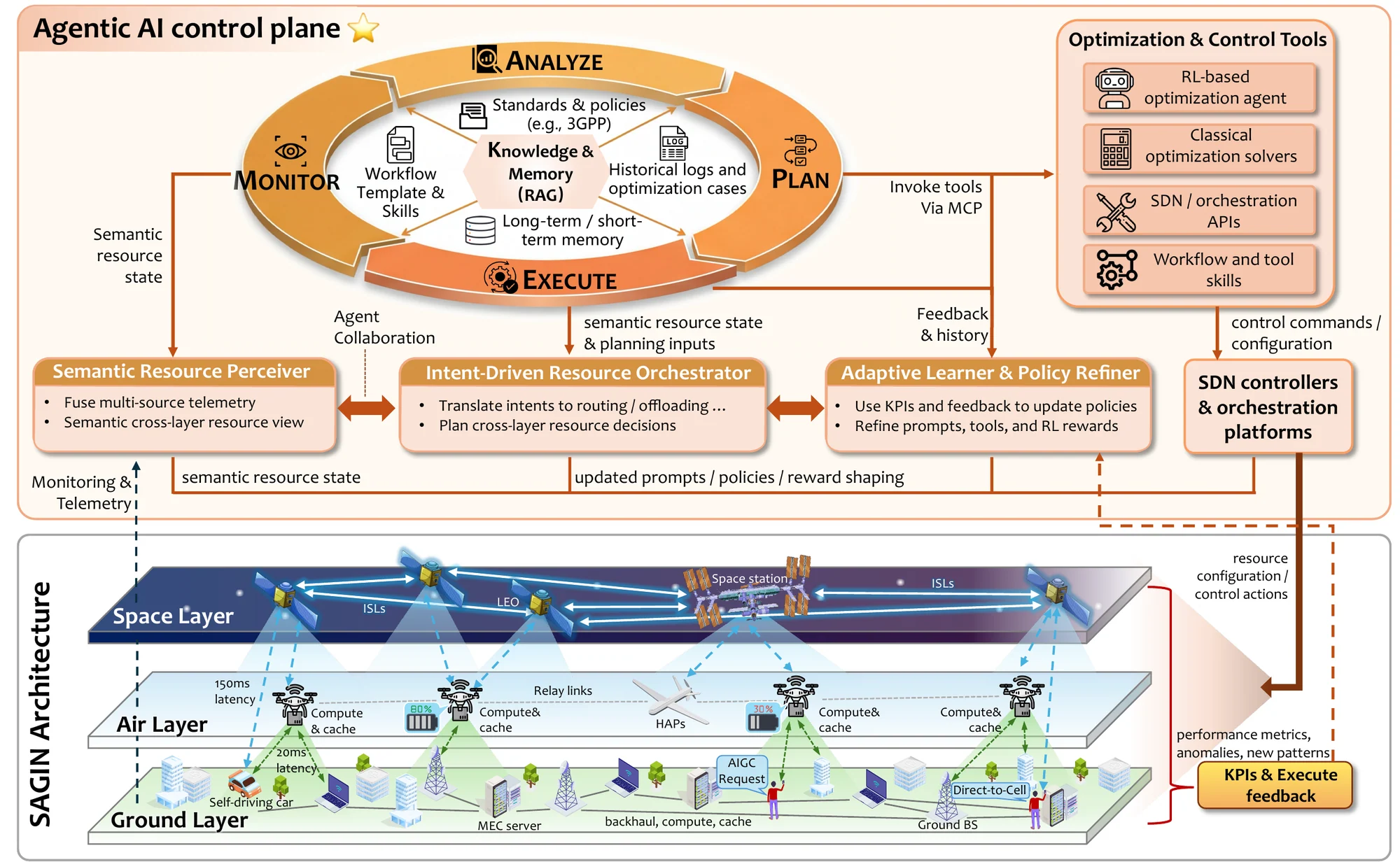
面向空天地网络的 Agentic AI 控制面。语义资源感知、意图驱动编排和反馈学习三类智能体构成 MAPE-K 闭环,结合大模型的慢时标编排与强化学习的快时标优化。

我是南京邮电大学通信与信息系统专业博士研究生,导师为赵海涛教授;2023 年在南京邮电大学获电子信息工程专业工学学士学位。2026 年 8 月起,在新加坡国立大学张瑞教授(新加坡工程院院士、IEEE Fellow)课题组联合培养。
我研究面向智能连接、承载智能业务的空天地一体化网络。网络交付的对象正从比特变为推理,我关心其中的基础问题:通信、计算与智能之间的权衡遵循什么规律,又该如何闭环驾驭。已有工作覆盖 Token 感知的多模态推理编排、任务预测增强的协同卸载、空天地分层拆分联邦学习,以及用智能体 AI 管理网络资源;近期聚焦面向大模型推理的通信-计算融合优化。
IEEE Transactions on Mobile Computing, pp. 1–18, 2026
The space-air-ground integrated network (SAGIN) can provide ubiquitous multimodal artificial intelligence-generated content (AIGC) services. In SAGIN, lightweight task-specific models hosted on uncrewed aerial vehicles (UAVs) provide low-latency inference, while full-scale foundation models deployed on low Earth orbit (LEO) satellites provide high-quality inference. However, efficient AIGC inference in SAGIN is hindered by the tight coupling between computation and cross-tier transmission under multi-timescale network dynamics. In this paper, we maximize the long-term per-user quality of experience (QoE), which captures both the generation quality and the end-to-end streaming latency of heterogeneous multimodal AIGC requests. To this end, we develop a unified token-level latency model that characterizes the time-to-first-token (TTFT) and the time-per-output-token (TPOT) along multi-tier offloading paths. We then formulate the joint optimization of model caching, UAV deployment, inference offloading, semantic compression, and resource allocation as a two-timescale mixed-integer nonlinear program (MINLP). For the slow-timescale subproblem, a knowledge-driven planner generates and evaluates candidate UAV deployment and model caching configurations from historical demand priors. For the fast-timescale subproblem, we propose a conditional diffusion twin delayed deep deterministic policy gradient (CD-TD3) algorithm with a hybrid action space, which optimizes offloading decisions, compression ratios, and resource allocation in real time. Simulation results show that the proposed framework improves the per-user QoE by 31.9% over TD3 and by 69.2% over the Greedy heuristic.
Linghao Zhang, Bo Xu, Haitao Zhao, Jinlong Sun, Jun Xiong, Xianbin Wang, “Token-Aware QoE Optimization for Multimodal AIGC Inference Tasks in Space-Air-Ground Integrated Networks”, IEEE Transactions on Mobile Computing, pp. 1–18, 2026, doi: 10.1109/TMC.2026.3743972.
@article{zhang2026tokenaware,
  author = {Zhang, Linghao and Xu, Bo and Zhao, Haitao and Sun, Jinlong and Xiong, Jun and Wang, Xianbin},
  title = {Token-Aware QoE Optimization for Multimodal AIGC Inference Tasks in Space-Air-Ground Integrated Networks},
  journal = {IEEE Transactions on Mobile Computing},
  year = {2026},
  pages = {1--18},
  doi = {10.1109/TMC.2026.3743972},
  note = {Early Access},
}IEEE Transactions on Vehicular Technology, pp. 1–16, 2026
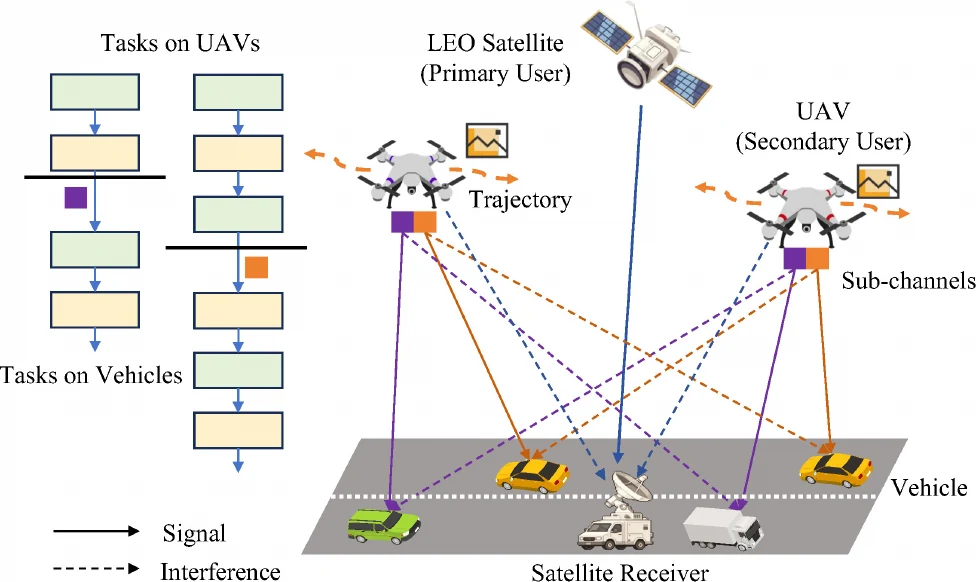
The Space-Air-Ground Integrated Network (SAGIN) has emerged as a pivotal architecture for sixth-generation (6G) mobile communication systems, offering extensive multi-domain and multi-dimensional coverage. To support intelligent services within SAGIN, deep neural network (DNN) inference tasks are often distributed across multiple devices due to the increasing scale of DNN parameters and constrained communication and computation resources. In this paper, to enhance intelligent services in the Internet of Vehicles (IoV), a cognitive-radio (CR)-enhanced SAGIN framework is proposed, where unmanned aerial vehicles (UAVs) are responsible for data collection and cooperate with vehicles to complete complex DNN inference tasks. A joint optimization problem that coordinates device association, model splitting with early exiting, resource allocation, and UAV trajectory planning is proposed to improve the average inference efficiency over a finite multi-round mission, defined as the average of the per-round ratios between aggregate inference accuracy and aggregate inference latency. Since the problem is highly coupled and non-convex, we decompose it into several subproblems and solve them iteratively. A quadratic unconstrained binary optimization (QUBO)-based graph attention network (GAT) approach with independent branch selection is proposed to solve the joint device association and model splitting problem, where a differentiable loss function is derived through Hamiltonian relaxation. In addition, we obtain a convex approximation of the transmit-power subproblem, while computation-resource allocation is solved as a convex optimization problem. For multi-round operations, we design a multi-agent reinforcement learning (MARL)-based trajectory optimization algorithm under a centralized training and decentralized execution paradigm. Simulation results on widely used DNN models, including AlexNet and VGG16, demonstrate that the proposed approach can improve the efficiency of collaborative DNN inference.
Bo Xu, Suyao Huang, Yukai Xu, Mengru Wu, Linghao Zhang, Jinlong Sun, Haitao Zhao, “Joint Task Offloading and Trajectory Optimization for Cooperative Multi-Branch DNN Inference in CR-SAGIN-Enhanced IoV”, IEEE Transactions on Vehicular Technology, pp. 1–16, 2026, doi: 10.1109/TVT.2026.3730653.
@article{xu2026joint,
  author = {Xu, Bo and Huang, Suyao and Xu, Yukai and Wu, Mengru and Zhang, Linghao and Sun, Jinlong and Zhao, Haitao},
  title = {Joint Task Offloading and Trajectory Optimization for Cooperative Multi-Branch DNN Inference in CR-SAGIN-Enhanced IoV},
  journal = {IEEE Transactions on Vehicular Technology},
  year = {2026},
  pages = {1--16},
  doi = {10.1109/TVT.2026.3730653},
  note = {Early Access},
}电子与信息学报, 2026
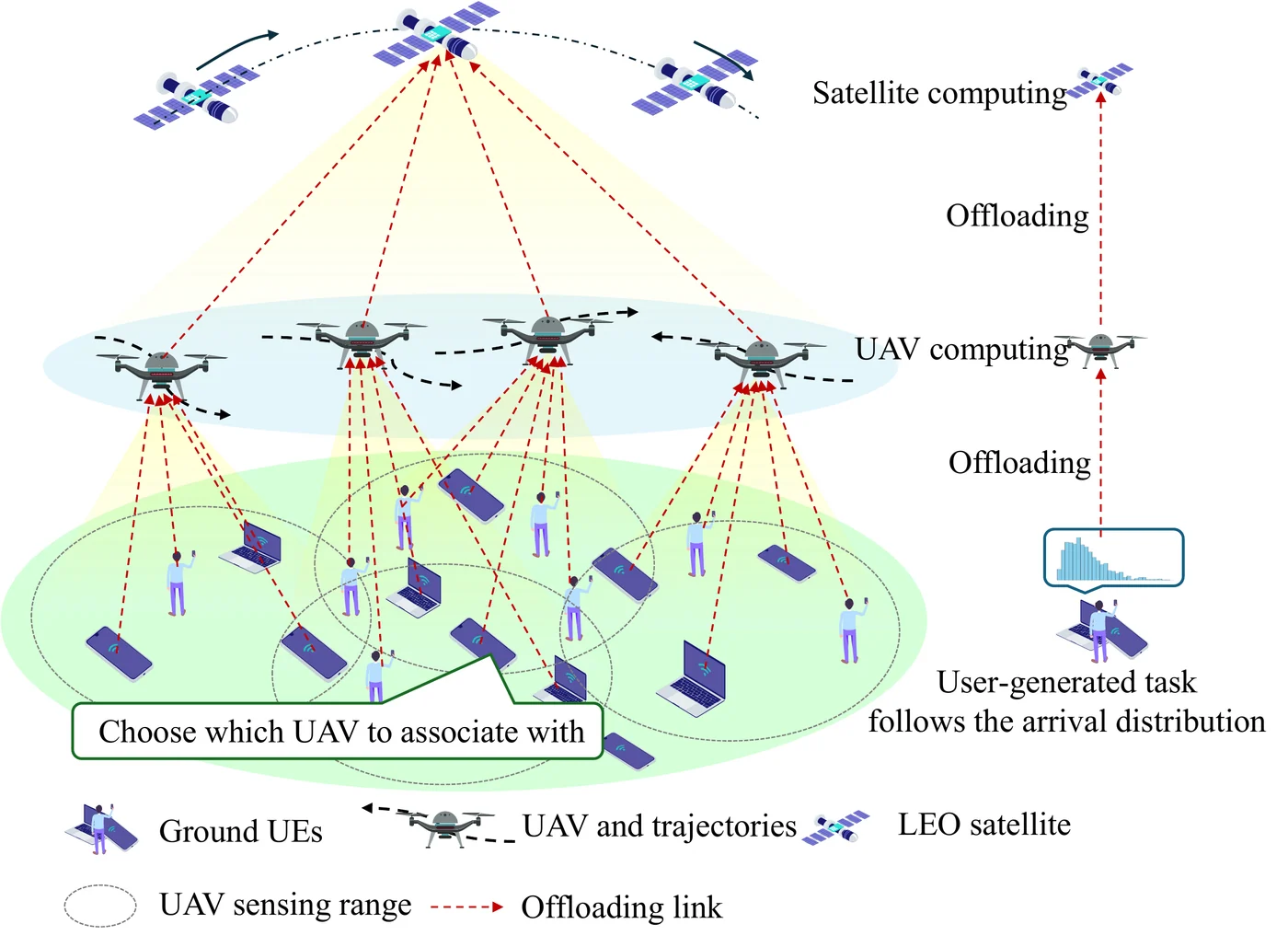
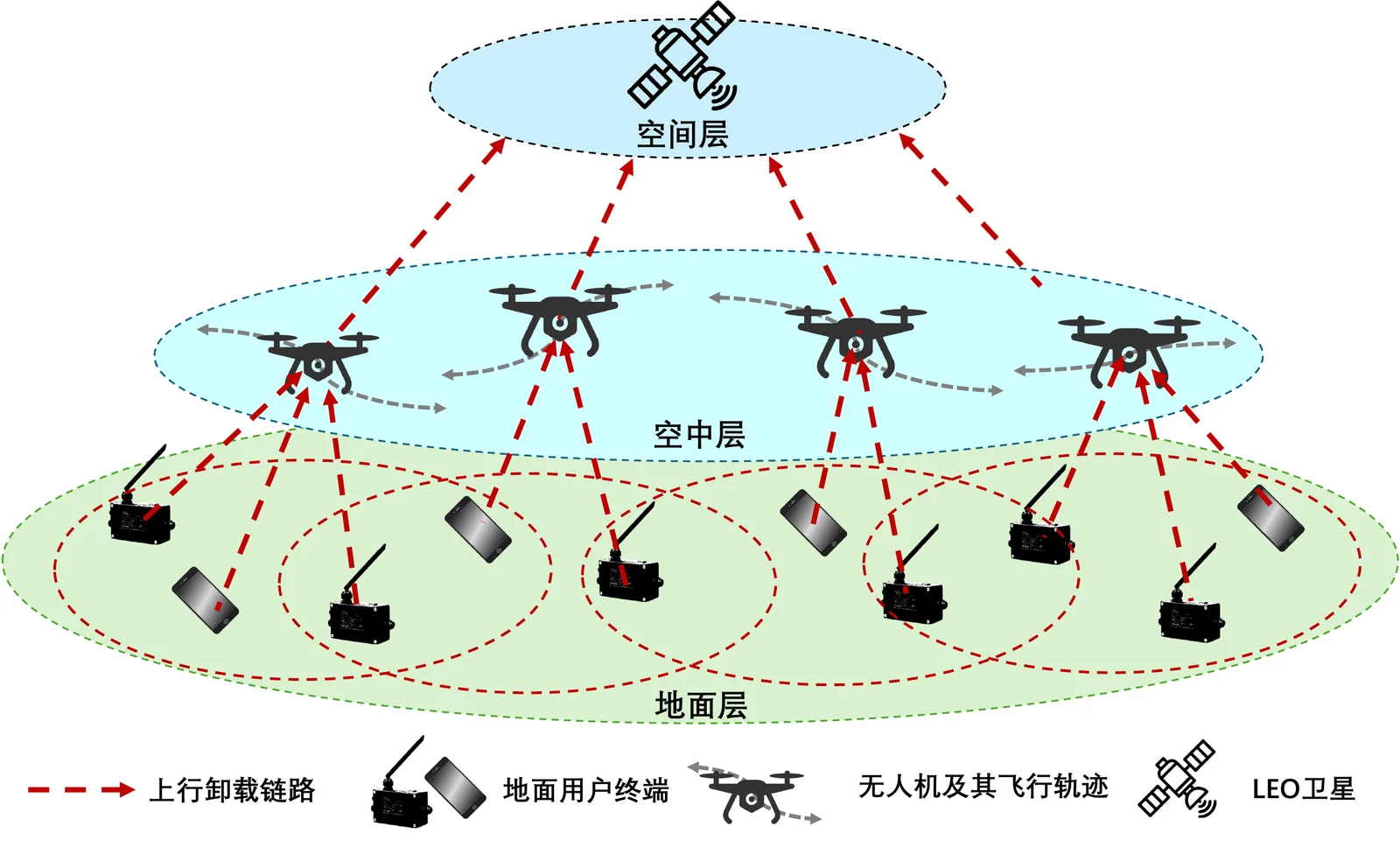
空天地一体化网络(SAGIN)通过低轨卫星(LEO)、无人机(UAV)与地面设备的协同,构建了面向计算密集型移动应用的高效融合架构。然而,由于无人机轨迹控制、任务卸载与资源分配之间存在强耦合关系,加之任务负载的动态性和不确定性,实现时延与能耗兼顾的高效任务卸载仍面临挑战。该文以任务完成时延与无人机飞行能耗加权成本最小化为优化目标,将优化问题建模为去中心化部分可观测马尔可夫决策过程(DEC-POMDP),并提出一种任务预测增强的多智能体近端策略优化算法(PA-MAPPO)。该方法在多智能体强化学习框架中引入轻量化任务负载预测模块,以增强多智能体之间的前瞻性决策能力,从而在动态SAGIN环境下实现无人机轨迹规划、任务卸载与计算资源分配的联合优化。仿真结果表明,所提算法能够有效降低系统综合成本,并在平均任务时延与无人机飞行能耗之间取得良好平衡。
张凌豪, 徐波, 孙金龙, 赖海光, 赵海涛, “任务预测增强的空天地一体化网络分层卸载方法”, 电子与信息学报, 2026, doi: 10.11999/JEIT260217.
@article{zhang2026task,
  author = {Zhang, Linghao and Xu, Bo and Sun, Jinlong and Lai, Haiguang and Zhao, Haitao},
  title = {A Task Prediction-Augmented Hierarchical Offloading Method for Space-Air-Ground Integrated Networks},
  journal = {Journal of Electronics \& Information Technology},
  year = {2026},
  doi = {10.11999/JEIT260217},
  note = {Online First},
}IEEE Network, pp. 1–8, 2026
Space-air-ground integrated networks (SAGIN) promise ubiquitous sixth-generation (6G) connectivity but face significant resource management challenges due to heterogeneous infrastructure, dynamic topologies, and stringent quality-of-service (QoS) requirements. Conventional model-driven approaches struggle with scalability and adaptability in such complex environments. This paper presents an agentic artificial intelligence (AI) framework for autonomous SAGIN resource management by embedding large language model (LLM)-based agents into a Monitor-Analyze-Plan-Execute-Knowledge (MAPE-K) control plane. The framework incorporates three specialized agents, namely semantic resource perceivers, intent-driven orchestrators, and adaptive learners, that collaborate through natural language reasoning to bridge the gap between operator intents and network execution. At the core of the framework is a hierarchical agent-reinforcement learning (RL) collaboration mechanism, wherein LLM-based orchestrators dynamically shape reward functions for RL agents based on semantic network conditions. Validation through unmanned aerial vehicle (UAV)-assisted AI-generated content (AIGC) service orchestration in energy-constrained scenarios demonstrates that LLM-driven reward shaping achieves 14% energy reduction and the lowest average service latency among all compared methods. This agentic paradigm offers a scalable pathway toward adaptive, AI-native 6G networks, capable of autonomously interpreting intents and adapting to dynamic environments.
Linghao Zhang, Haitao Zhao, Bo Xu, Hongbo Zhu, Xianbin Wang, “Agentic AI for SAGIN Resource Management: Semantic Awareness, Orchestration, and Optimization”, IEEE Network, pp. 1–8, 2026, doi: 10.1109/MNET.2026.3695611.
@article{zhang2026agentic,
  author = {Zhang, Linghao and Zhao, Haitao and Xu, Bo and Zhu, Hongbo and Wang, Xianbin},
  title = {Agentic AI for SAGIN Resource Management: Semantic Awareness, Orchestration, and Optimization},
  journal = {IEEE Network},
  year = {2026},
  pages = {1--8},
  doi = {10.1109/MNET.2026.3695611},
  note = {Early Access},
}IEEE Signal Processing Letters, vol. 33, pp. 1571–1575, 2026
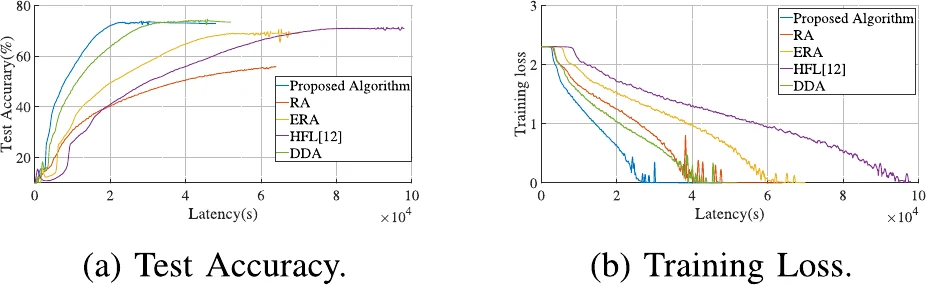
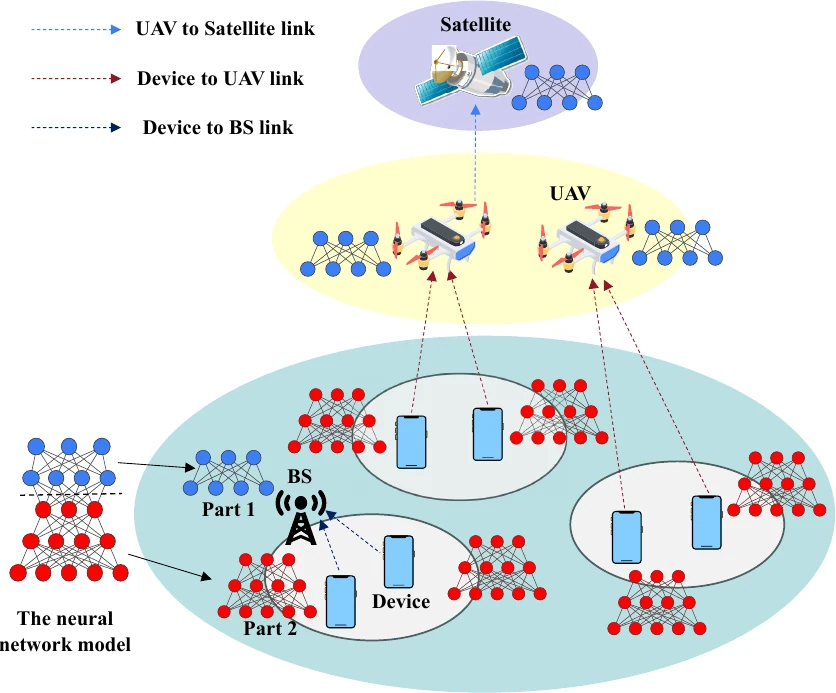
Federated Learning (FL) confronts challenges such as resource constraints and unbalanced data distribution in the Space-Air-Ground Integrated Network (SAGIN). This paper proposes a Hierarchical Split Federated Learning (HSFL) framework considering satellite handoff and derives its upper bound of loss function affected by model splitting and data distribution. To minimize the weighted sum of training loss and latency, we formulate a joint optimization problem that integrates device association, model split layer selection, and resource allocation. We decompose the original problem into several subproblems, where an iterative optimization algorithm incorporating closed-form solutions and brute-force split point search is proposed. Simulation results demonstrate that the proposed algorithm can balance training efficiency and model accuracy for FL in SAGIN.
Haitao Zhao, Xiaoyu Tang, Bo Xu, Jinlong Sun, Linghao Zhang, “Convergence Analysis and Resource Allocation for Hierarchical Split Federated Learning Over Space-Air-Ground Integrated Networks”, IEEE Signal Processing Letters, vol. 33, pp. 1571–1575, 2026, doi: 10.1109/LSP.2026.3682189.
@article{zhao2026convergence,
  author = {Zhao, Haitao and Tang, Xiaoyu and Xu, Bo and Sun, Jinlong and Zhang, Linghao},
  title = {Convergence Analysis and Resource Allocation for Hierarchical Split Federated Learning Over Space-Air-Ground Integrated Networks},
  journal = {IEEE Signal Processing Letters},
  year = {2026},
  volume = {33},
  pages = {1571--1575},
  doi = {10.1109/LSP.2026.3682189},
}IEEE Transactions on Vehicular Technology, vol. 75, no. 9, pp. 20912–20925, 2026
Space-Air-Ground Integrated Networks (SAGINs) play a crucial role in the 6G system, offering global coverage and ultra-wide-area broadband access. Meanwhile, advancements in artificial intelligence (AI) have led to a significant increase in model inference demands with stringent latency requirements. In this paper, considering the intelligent services in SAGINs, we explore task offloading for the co-inference problem and improve the inference efficiency by performing model splitting, device association, and resource allocation. This problem is solved iteratively by decomposing it into multiple sub-problems. In particular, the bandwidth allocation problem is solved using convex optimization techniques to obtain a closed-form solution, and the model splitting problem is addressed by systematically searching for the optimal split points. Besides, the joint device association and computing resource allocation problem is reformulated into a monotone submodular function without the satellite, and a low-complexity submodular optimization algorithm is proposed. To further utilize the computing power of the satellite, we introduce a resource reallocation algorithm based on the existing optimization results. These sub-problems iterate alternately until the optimization goal converges. The simulation results show that the proposed algorithm can achieve better latency performance in several inference tasks.
Haitao Zhao, Suyao Huang, Bo Xu, Linghao Zhang, Mengru Wu, Jinlong Sun, “Hastening Co-Inference in Space-Air-Ground Integrated Networks: A Submodular Optimization Based Task Offloading Approach”, IEEE Transactions on Vehicular Technology, vol. 75, no. 9, pp. 20912–20925, 2026, doi: 10.1109/TVT.2026.3681626.
@article{zhao2026hastening,
  author = {Zhao, Haitao and Huang, Suyao and Xu, Bo and Zhang, Linghao and Wu, Mengru and Sun, Jinlong},
  title = {Hastening Co-Inference in Space-Air-Ground Integrated Networks: A Submodular Optimization Based Task Offloading Approach},
  journal = {IEEE Transactions on Vehicular Technology},
  year = {2026},
  volume = {75},
  number = {9},
  pages = {20912--20925},
  doi = {10.1109/TVT.2026.3681626},
}IEEE Transactions on Vehicular Technology, vol. 75, no. 8, pp. 18175–18191, 2026
The space-air-ground integrated network (SAGIN) can provide a promising architecture for computation-intensive mobile applications through the complementary advantages of unmanned aerial vehicles (UAVs) and low Earth orbit (LEO) satellites. However, efficient task offloading remains challenging due to the strong coupling among UAV trajectories, user association, and resource allocation, especially with dynamic and uncertain task workloads. In this paper, we aim to minimize the average task completion delay by enabling UAVs and satellites to cooperatively assist users in executing complex computational tasks. We formulate the joint optimization problem as a decentralized partially observable Markov decision process (DEC-POMDP), where task workload prediction is incorporated to enhance foresight and coordination among agents. Then, a task-prediction-augmented multi-agent collaborative offloading (TAMACO) framework is proposed, which integrates task-prediction-augmented multi-agent proximal policy optimization (TA-MAPPO) for UAV trajectory control. Meanwhile, a prediction-augmented coalition formation game (PA-CFG) algorithm embedded into TA-MAPPO is proposed to solve the joint problem of user association and computing resource allocation. Simulation results demonstrate that the proposed TAMACO framework achieves up to 19.3% reduction in average task completion delay compared to non-predictive baselines, validating its effectiveness for real-time task offloading in dynamic SAGIN.
Linghao Zhang, Bo Xu, Haitao Zhao, Suyao Huang, Qin Wang, Hongbo Zhu, “Task-Prediction-Augmented Multi-Agent Collaborative Offloading in Space-Air-Ground Integrated Network”, IEEE Transactions on Vehicular Technology, vol. 75, no. 8, pp. 18175–18191, 2026, doi: 10.1109/TVT.2026.3676287.
@article{zhang2026taskpredictionaugmented,
  author = {Zhang, Linghao and Xu, Bo and Zhao, Haitao and Huang, Suyao and Wang, Qin and Zhu, Hongbo},
  title = {Task-Prediction-Augmented Multi-Agent Collaborative Offloading in Space-Air-Ground Integrated Network},
  journal = {IEEE Transactions on Vehicular Technology},
  year = {2026},
  volume = {75},
  number = {8},
  pages = {18175--18191},
  doi = {10.1109/TVT.2026.3676287},
}arXiv 预印本, 2026
The emergence of large language model (LLM)-based agent frameworks has shifted the primary challenge in building domain-expert AI agents from raw capability to effective encoding of domain expertise. Two dominant paradigms—code-first development, which embeds expertise in deterministic pipelines, and prompt-first development, which captures expertise in static system prompts—both treat agent construction as a discrete engineering phase preceding deployment. We argue that this sequential assumption creates a fundamental mismatch with the nature of domain expertise, which is substantially tacit, deeply personal, and continuously evolving. We propose Nurture-First Development (NFD), a paradigm in which agents are initialized with minimal scaffolding and progressively grown through structured conversational interaction with domain practitioners. The central mechanism is the Knowledge Crystallization Cycle, whereby fragmented knowledge embedded in operational dialogue is periodically consolidated into structured, reusable knowledge assets. We formalize NFD through: (1) a Three-Layer Cognitive Architecture organizing agent knowledge by volatility and personalization degree; (2) the Knowledge Crystallization Cycle with formal definitions of crystallization operations and efficiency metrics; and (3) an operational framework comprising a Dual-Workspace Pattern and Spiral Development Model. We discuss the conditions, limitations, and broader implications of NFD for human-agent co-evolution.
Linghao Zhang, “Nurture-First Agent Development: Building Domain-Expert AI Agents Through Conversational Knowledge Crystallization”, arXiv 预印本, 2026.
@misc{zhang2026nurturefirst,
  author = {Zhang, Linghao},
  title = {Nurture-First Agent Development: Building Domain-Expert AI Agents Through Conversational Knowledge Crystallization},
  howpublished = {arXiv:2603.10808},
  year = {2026},
  url = {https://arxiv.org/abs/2603.10808},
}2025 IEEE 36th International Symposium on Personal, Indoor and Mobile Radio Communications (PIMRC), pp. 1–6, 2025
Space-air-ground integrated vehicular networks (SAGVN) play a crucial role in the 6G system, offering global coverage and ultra-wide-area broadband access. Meanwhile, advancements in artificial intelligence (AI) have led to a significant increase in model inference demands, which come with stringent latency requirements. In this paper, considering the intelligent services in SAGVN, we explore the co-inference problem and improve the inference efficiency by performing model splitting, vehicle association, and resource allocation. This problem is solved iteratively by decomposing it into multiple sub-problems. In particular, the model splitting problem is addressed by systematically searching for the optimal split points. Besides, the joint vehicle association and resource allocation problem are reformulated into a monotone submodular function without satellites, and then a low-complexity submodular optimization algorithm is proposed. To further utilize the computing power of the satellite, we further introduce a resource reallocation algorithm based on the existing optimization results. These two subproblems can iterate alternately until the optimization goal converges. Simulation results show that the proposed algorithm can achieve better latency performance in several inference tasks.
Suyao Huang, Bo Xu, Guijin Tang, Haotong Cao, Linghao Zhang, Haitao Zhao, “Submodular Optimization Based Co-Inference in Space-Air-Ground Integrated Vehicular Networks”, 2025 IEEE 36th International Symposium on Personal, Indoor and Mobile Radio Communications (PIMRC), pp. 1–6, 2025, doi: 10.1109/PIMRC62392.2025.11275599.
@inproceedings{huang2025submodular,
  author = {Huang, Suyao and Xu, Bo and Tang, Guijin and Cao, Haotong and Zhang, Linghao and Zhao, Haitao},
  title = {Submodular Optimization Based Co-Inference in Space-Air-Ground Integrated Vehicular Networks},
  booktitle = {2025 IEEE 36th International Symposium on Personal, Indoor and Mobile Radio Communications (PIMRC)},
  year = {2025},
  pages = {1--6},
  doi = {10.1109/PIMRC62392.2025.11275599},
}2025 IEEE/CIC International Conference on Communications in China (ICCC), pp. 1–6, 2025
The rapid advancement of the Industrial Internet of Things (IIoT) demands distributed machine learning frameworks with enhanced communication reliability and data privacy. To address the limitations of conventional federated learning (FL) in single-server architectures, such as restricted device participation and single-point failure risks, we propose a device-to-device (D2D) assisted semi-decentralized FL framework (D2D-SD-FL). The framework leverages D2D communication to expand device participation and employs a multi-server aggregation mechanism to improve training efficiency. During intra-cluster aggregation, D2D pairs transmit local models through coordinated device interactions, mitigating the impact of packet error rate (PER) caused by unreliable wireless channels. Multi-server coordination ensures global model consensus for inter-cluster aggregation, preventing training interruptions due to server or link failures. Through convergence analysis, we formulate an optimization problem to minimize global training loss and propose a multiphase optimization scheme of D2D pairing and scheduling among multiple edge servers. Experimental results on MNIST, FashionMNIST, and CIFAR-10 datasets demonstrate that the proposed framework achieves superior test accuracy and reduces training loss compared to baseline methods.
Hongqi Sun, Haitao Zhao, Bo Xu, Jinlong Sun, Linghao Zhang, “D2D-Assisted High-Reliability Wireless Federated Learning for Industrial Internet of Things”, 2025 IEEE/CIC International Conference on Communications in China (ICCC), pp. 1–6, 2025, doi: 10.1109/ICCC65529.2025.11148909.
@inproceedings{sun2025ddassisted,
  author = {Sun, Hongqi and Zhao, Haitao and Xu, Bo and Sun, Jinlong and Zhang, Linghao},
  title = {D2D-Assisted High-Reliability Wireless Federated Learning for Industrial Internet of Things},
  booktitle = {2025 IEEE/CIC International Conference on Communications in China (ICCC)},
  year = {2025},
  pages = {1--6},
  doi = {10.1109/ICCC65529.2025.11148909},
}物联网学报, 2025
在空天地一体化网络 (SAGIN, space-air-ground integrated network) 中,通过推理已训练的深度神经网络 (DNN, deep neural network) 能够实现多样化的人工智能 (AI, artificial intelligence) 服务。由于 DNN 的参数量不断增大,在有限的通信和计算资源下,推理任务的执行过程通常需要多方的合作。本论文将认知无线电技术 (CR, cognitive radio) 融入 SAGIN 中,以最小化合作推理时延为目标,在卫星通信干扰阈值约束、设备服务质量约束以及发射功率约束下,以无人机 (UAV, unmanned aerial vehicle) 为推理任务的发起者建立考虑设备关联、模型分割以及功率优化的合作推理问题。该问题是多维变量耦合的非凸问题,本文根据优化变量将原问题分解,提出一种融合二次无约束二值优化 (QUBO, quadratic unconstrained binary optimization) 和注意力机制的图学习法,将目标函数和约束条件建模为 QUBO 形式,并且通过哈密尔顿量松弛生成可微的损失函数,进而利用动态多头注意力机制对图结构问题中的节点信息进行聚合,从而完成设备关联和模型分割优化。此外,使用连续凸逼近 (SCA, successive convex approximation) 对发射功率进行优化,最后对三部分子问题交替迭代求解。仿真结果表明,所提方法能够将合作推理任务总时延降低 11%。
徐煜凯, 徐波, 张凌豪, 王琴, 赵海涛, “基于图学习的空天地一体化网络合作推理方法研究”, 物联网学报, 2025.
@article{xu2025research,
  author = {Xu, Yukai and Xu, Bo and Zhang, Linghao and Wang, Qin and Zhao, Haitao},
  title = {Research on Graph Learning-Based Co-Inference Method for Space-Air-Ground Integrated Networks},
  journal = {Chinese Journal on Internet of Things},
  year = {2025},
  url = {https://link.cnki.net/urlid/10.1491.tp.20250807.1640.004},
  note = {Online First},
}IEEE Internet of Things Journal, vol. 12, no. 8, pp. 10795–10807, 2025
The development of Industrial Internet of Things (IIoT) applications presents a critical challenge in terms of latency limitation, particularly considering the limited availability of resources that prevent a single fog device from fully executing large-scale computing tasks. In such scenarios, enabling distributed computing across multiple fog servers or collaborating with cloud servers holds promising potential. To improve the efficiency of task offloading while accounting for the crucial role of movable fog devices (e.g., robots and unmanned cars), we formulate a joint optimization problem as a partially observable Markov decision process (POMDP), incorporating offloading decisions, computing resource allocation, and trajectory optimization under constraints related to available resources and collision avoidance. Due to the nondeterministic polynomial-time hardness (NP-hardness) in the problems of task offloading and resource allocation, we reformulate a matroid-constrained submodular maximization problem and propose an iterative low-complexity algorithm to find solutions. Subsequently, extracting better solutions from submodular optimization, we propose a multiagent reinforcement learning (MARL)-based algorithm to solve the trajectory optimization problem for the movable fog devices acting as agents, making decisions based on their local observations. Finally, simulation results have validated that the proposed scheme has a superior performance compared to the baselines.
Bo Xu, Haitao Zhao, Haotong Cao, Chun Zhu, Jinlong Sun, Linghao Zhang, Hongbo Zhu, “Mobility-Aware Task Offloading in Industrial Fog Networks: A Submodular-Based MARL Approach”, IEEE Internet of Things Journal, vol. 12, no. 8, pp. 10795–10807, 2025, doi: 10.1109/JIOT.2024.3514095.
@article{xu2025mobilityaware,
  author = {Xu, Bo and Zhao, Haitao and Cao, Haotong and Zhu, Chun and Sun, Jinlong and Zhang, Linghao and Zhu, Hongbo},
  title = {Mobility-Aware Task Offloading in Industrial Fog Networks: A Submodular-Based MARL Approach},
  journal = {IEEE Internet of Things Journal},
  year = {2025},
  volume = {12},
  number = {8},
  pages = {10795--10807},
  doi = {10.1109/JIOT.2024.3514095},
}